See what the board sees
The Turing Pi 2 has a temperature sensor. Upstream's device tree never described it, so nothing could read it — and the fan, having nothing to regulate against, ran at a fixed speed somebody had once written down.

This fork adds the sensor to the device tree and lets the kernel's thermal governor drive the fan from it. That is a two-line change with a consequence worth an article: the board became explicable.
"Why is the fan on 4?"
That question is what started this. A fan control showing 4 with no
explanation reads as someone set this to 4, and the honest answer is that
nobody did — the governor did, and it was right.
The governor is step_wise. The device tree declares five trip points, and
the fan's step follows the highest active trip the board is above:
| trip | temperature | fan step |
|---|---|---|
fan_min |
20 °C | 3 |
fan_low |
45 °C | 4 |
fan_mid |
60 °C | 5 |
fan_high |
70 °C | 6 |
hot |
95 °C | kernel escalation |
So a board sitting at 50 °C is on step 4 because it is above 45 and below 60. There was never a mystery — only a number with its reason removed.
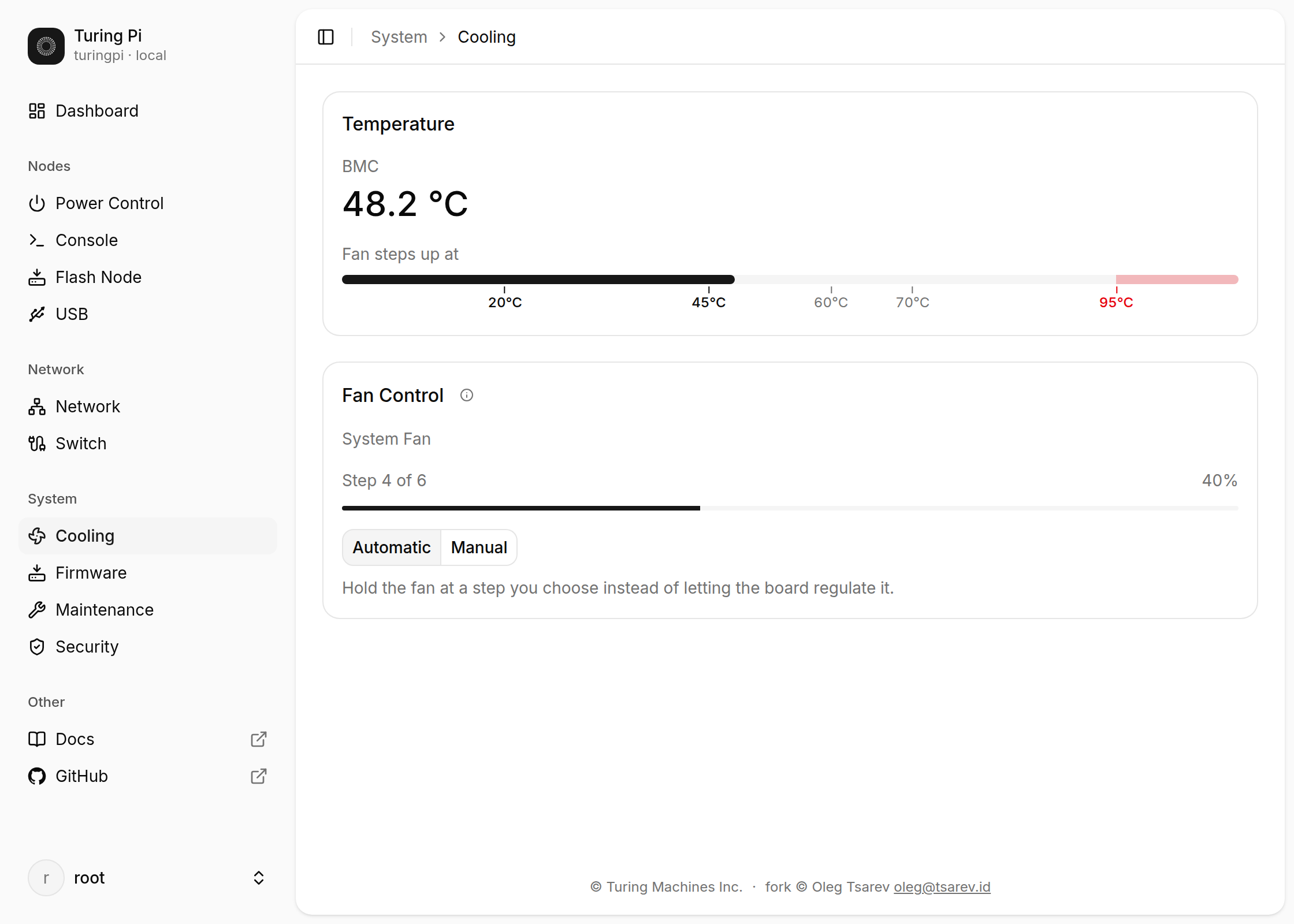
The daemon now reports the trips it read from sysfs, and both clients say which one is in force:
The 40% is not step 4 of 6 as a fraction. It is the PWM duty that step
commands, read from the board's own cooling-levels table — which is
0, 16, 32, 64, 102, 170, 254 and is not linear. An interface that divided
4 by 6 and said 67% would be inventing a number about hardware it had not
looked at.
And when you want the fan somewhere else
Reading the governor's mind is most of the answer. The rest is being able to overrule it — and until v2.14.0 the interface offered a slider that could not. Dragging it wrote a step the kernel took back within a poll, so the control appeared to work, sprang back, and taught the operator not to trust the page.
The slider now sits behind an explicit Override switch, which pauses the zone's governor for as long as it is on:
$ tpi cooling set "system fan" 6 --hold
$ tpi cooling status
|----Device-----|-Speed-|-Max Speed-|-Governor-|
|system fan | 6| 6| paused|
$ tpi cooling set "system fan" --auto
Turning it on does not move the fan. Whatever step the governor has it on becomes the step it is held at, so the only thing that changes is who is deciding.
The switch appears only where a step would actually hold — where the daemon reports both a governor it can pause and the state of that governor. On an older daemon there is no switch and the plain slider stays, under its note admitting the governor undoes it. A control that visibly fails is worse than one that admits it cannot.
What is not underneath you
This board declares no critical trip. Nothing shuts it down if it gets
hot — with the governor running or paused. So a held fan is taken back
automatically above the zone's hottest active trip, 70 °C here, read
from the trips rather than written down as a number.
That is a daemon doing it, not a kernel, which is a weaker guarantee than it sounds. See what is and isn't fixed.
Read from the board, never written into a client
Every figure above is read at runtime: the trips from /sys/class/thermal,
the duty table from the device tree, the step from the cooling device. None
of it is a constant in the daemon or the web interface.
That rule costs a little code and buys the only property that matters here — the numbers cannot go stale relative to the board they describe. A table copied into a client is correct until someone changes the device tree, and then it is a confident lie.
A catalogue, not a number
Upstream exposes no metrics at all. This fork serves a catalogue of them: temperatures and the cooling state, per-port switch traffic and errors, node power and uptime, NAND wear, memory and load, the clock's discipline and offset, the firmware slots, and the health gate's own record.
They are served on a port that reaches nothing else — 9110, plain HTTP,
no credential. Adding metrics behind the root password would have been worse
than having none — a scrape config is a file on another machine, and it should
not be able to power off a node.
One of these is about this fork's own mistakes
bmcd_process_resident_bytes was added on 2026-09-09, the night a board
ran out of memory and stopped answering. The board-level memory metric
could show that it was being consumed and not by what, so the
diagnosis had to be argued from timing. One number closes that gap. See
what is and isn't fixed.