Skip to content

Pick a version, from anywhere

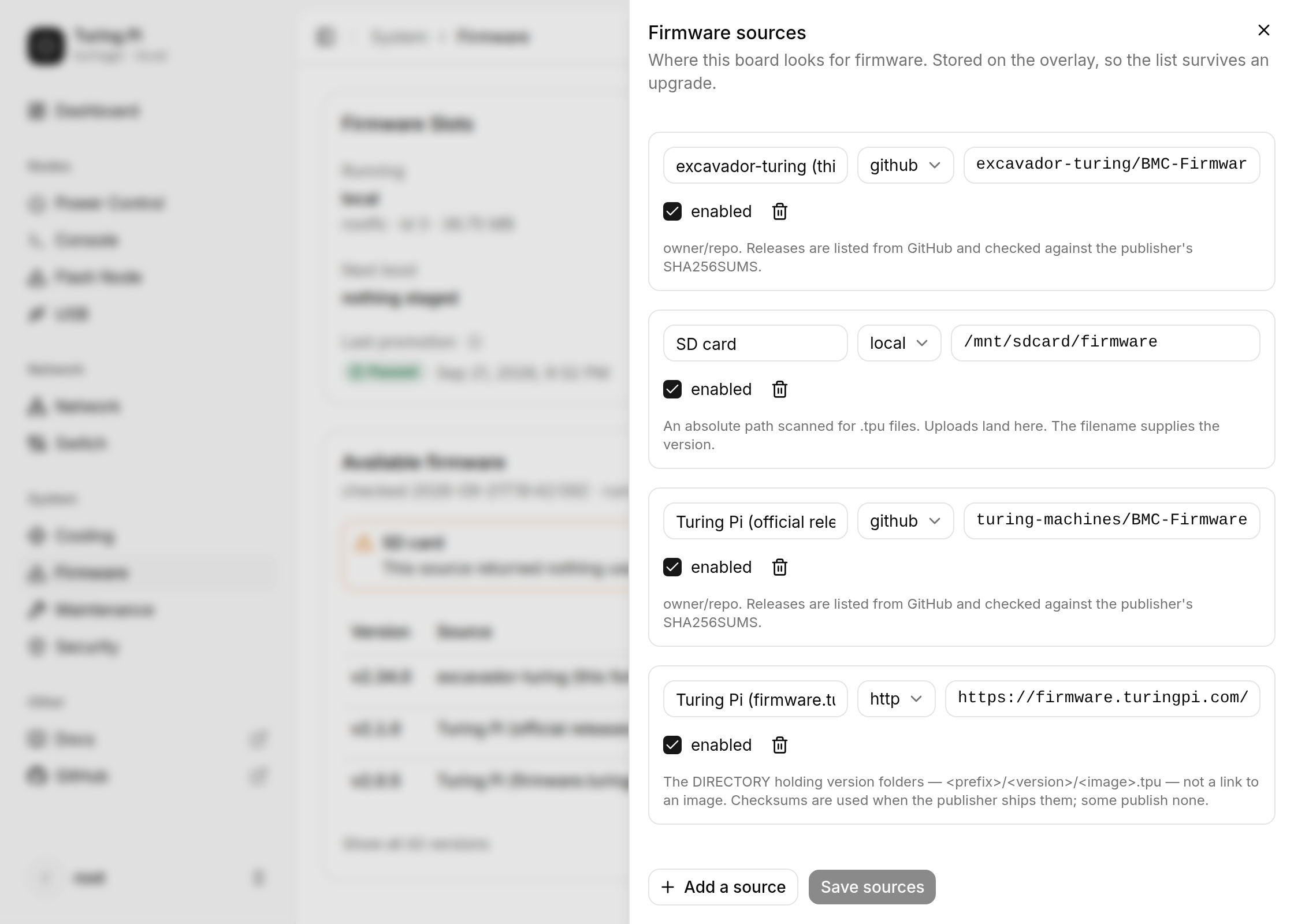
Upstream's board has one firmware source, hard-coded, and it disagrees with itself. Its firmware mirror stops at v2.0.5 while its GitHub releases reach v2.1.0 — the same publisher, two catalogues, and following the documented update path would downgrade a board running anything newer.

Every configured source, side by side: this fork, upstream's two catalogues, and the SD card — with each candidate's checksum state, and an honest error where a source had nothing.

Every configured source, side by side: this fork, upstream's two catalogues, and the SD card — with each candidate's checksum state, and an honest error where a source had nothing.

This fork makes the sources a setting, and shows you what each one offers.

Every source, with what it is worth

A source is GitHub releases, an HTTP directory, or a path on the SD card. Each candidate is listed with two independent facts:

How it compares to what is running — newer, current, older, or genuinely not comparable. Compared numerically, because "2.10.0" < "2.9.0" as text and that bug is invisible until the tenth minor release. A release candidate sorts before its own release, which GNU sort -V gets backwards.

How much is known about it, which is a different question:

trust means
verified the publisher shipped a checksum and it was checked on download
tls-only the publisher ships no checksums at all — upstream's HTTP mirror does not
unverified a local file, whose provenance is whatever put it there

Three genuinely different things. Rendering them alike would be worse than omitting the column.

An upload is a file, not an event

Uploading a firmware image used to be the install: the daemon wrote it to a scratch directory, ran the updater on it immediately, and deleted the directory. So an upload was never a thing you had, only a thing that happened — and the upload form was a second way to install that bypassed the version list entirely. Somebody could upload one image and install another with the page never showing which.

Now an upload parks: the image is written to the SD card and nothing else happens. It appears in the list beside every other candidate, marked unverified because that is what a file of unknown provenance is, and installing it is a separate and visible choice.

That also makes the development loop honest. Park a build, install it, reboot, park the next one — each step is a thing you did, not a side effect.

What a source cannot do

A source that is unreachable reports its own error, next to its own name. It never blanks the others, and an error is never rendered as "nothing new" — those are different claims, and only the person reading knows which one they are about to act on.

The catalogue answers from cache and re-polls behind the answer, so pressing Check now does not freeze the page while four sources are contacted. Before that change it took 16 seconds and held a lock the whole time, which froze every other request as well.

From the shell, too

Everything above is on the command line, because a feature that exists only in a browser is shipped to the half of the workflow that cannot be automated:

$ tpi firmware list
running v2.9.2
staged  v2.10.0  (reboot to take it)

VERSION    SOURCE  TRUST       SIZE
= v2.9.2   local   unverified  37.2 MB
^ v2.10.0  fork    verified

$ tpi firmware check || echo "there is an upgrade"

firmware check exits 10 when an upgrade exists, so it works from cron without parsing output. It is deliberately not 1, which stays "the command failed".